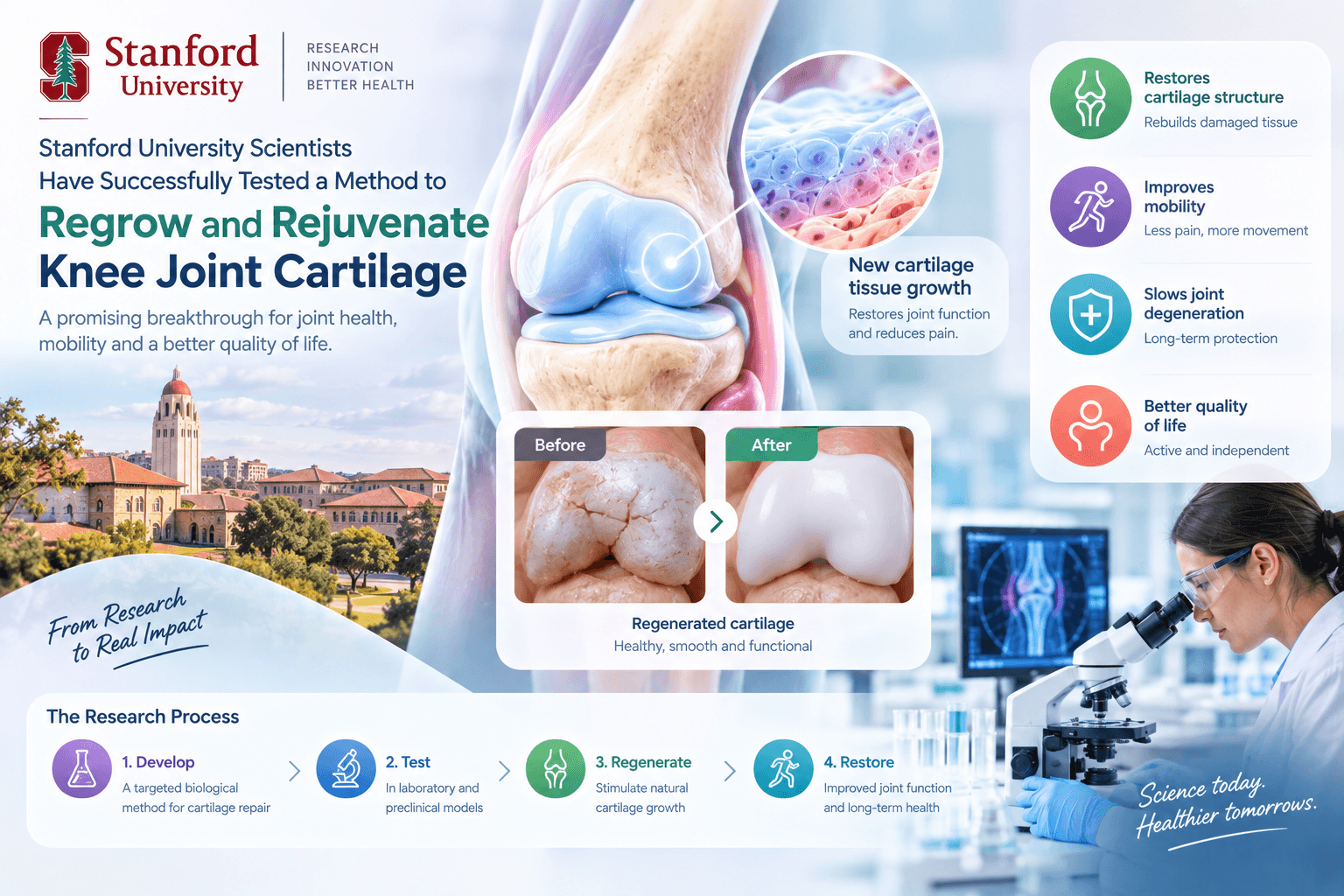
Recent medical discoveries offer immense hope for treating a problem long considered irreversible — cartilage degradation and osteoarthritis. Researchers at Stanford University experimented with specific proteins governing aging cellular activity, demonstrating in practice that damaged joint cartilage can be regrown.
The Root of the Problem: Why Doesn't Cartilage Repair Itself?
Because smooth hyaline cartilage covering joint surfaces lacks blood vessels, it cannot naturally regenerate when injured or worn down by age. Consequently, bones begin to rub against each other, causing severe pain, inflammation, and limited mobility. Until now, the only solutions have been pain management or total joint replacement surgery.
Scientific Breakthrough: Rejuvenation by Stopping the Aging Process
Researchers focused on a protein named 15-PGDH, which accumulates as the body ages and drives tissue degradation. By using a specialized small-molecule inhibitor, scientists blocked the activity of this protein: